
Description
PrymaLab · Research Use Only
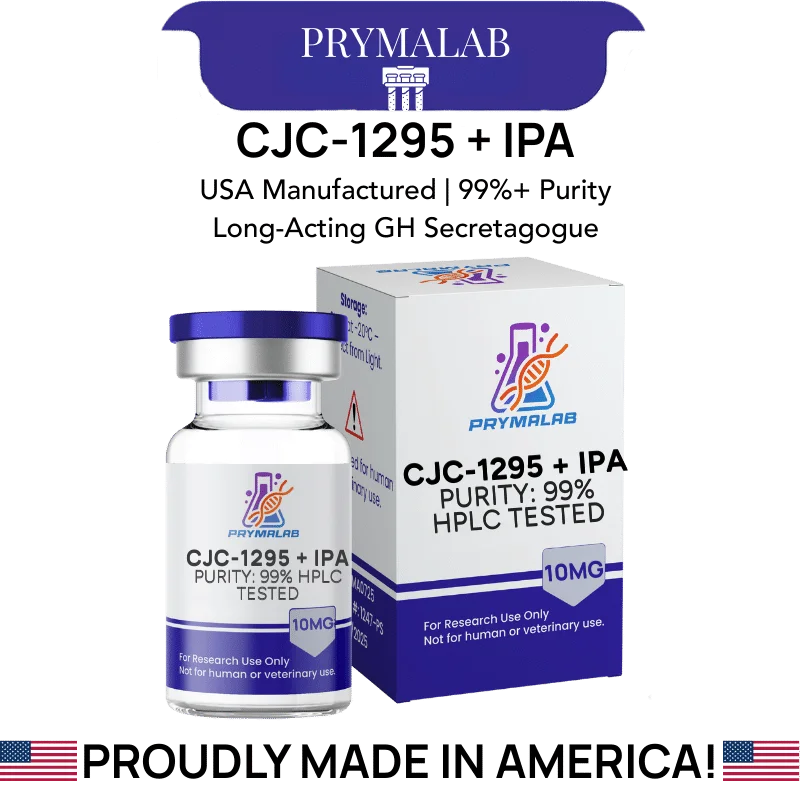
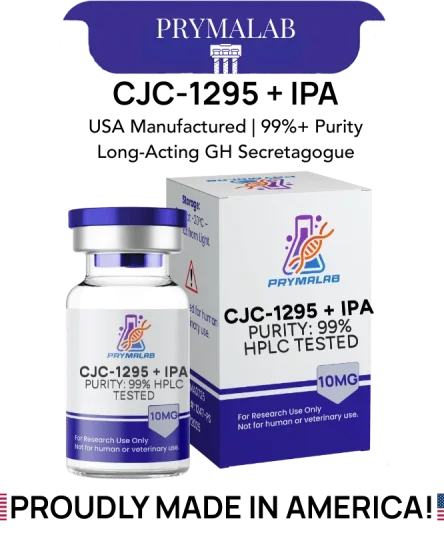
CJC-1295 / Ipamorelin 10mg Blend
Two receptors, two mechanisms · GHRHR + GHS-R1a · 5mg + 5mg
CJC-1295 Ipamorelin blend 10mg is a lyophilized vial containing Modified GRF (1-29) and ipamorelin at 5mg each. The two compounds act on separate receptors. Modified GRF (1-29) targets the GHRH receptor on pituitary somatotrophs. Ipamorelin, a pentapeptide, targets the ghrelin receptor GHS-R1a.
Specification Table
| Property | Value |
|---|---|
| Total peptide content | 10 mg |
| Component 1 | Modified GRF (1-29), 5 mg |
| Component 2 | Ipamorelin, 5 mg |
| CAS, Modified GRF (1-29) | 863288-34-0 |
| CAS, Ipamorelin | 170851-70-4 |
| Molecular formula, Ipamorelin | C38H49N9O5 |
| Molecular weight, Ipamorelin | 711.85 g/mol |
| Molecular weight, Modified GRF (1-29) | Approximately 3367.9 g/mol |
| Sequence, Ipamorelin | Aib-His-D-2-Nal-D-Phe-Lys-NH2 |
| Residue count, Ipamorelin | 5 (pentapeptide) |
| Residue count, Modified GRF (1-29) | 29 |
| Target, Modified GRF (1-29) | GHRH receptor (GHRHR) |
| Target, Ipamorelin | Growth hormone secretagogue receptor 1a (GHS-R1a), the ghrelin receptor |
| Reported selectivity, Ipamorelin | Did not raise ACTH or cortisol above GHRH-stimulated levels in the primary study |
| Molar ratio in vial | Approximately 1 : 4.7 (Modified GRF (1-29) : ipamorelin) |
| Appearance | White lyophilized cake |
| Purity | Per lot-specific certificate of analysis |
| Solubility | Soluble in bacteriostatic water and sterile water |
| Storage, lyophilized | -20°C, protected from light and moisture |
| Storage, reconstituted | 2-8°C, protected from light |
| Reconstituted stability | Not established for this mixture |
| Regulatory status | No approved human or veterinary formulation for either component |
Why Combine Two Different Receptors?
Growth hormone release from the pituitary gland is governed by more than one stimulatory input acting in parallel. GHRH supplies the primary signal through its own dedicated receptor. Ghrelin acts at GHS-R1a to supply a second and mechanistically separate input, routed through a different G-protein coupling entirely. Somatostatin restrains both of them simultaneously.
Because the two stimulatory receptors converge on the same cell through different signalling routes, activating both simultaneously is a distinct experimental condition from activating either alone. GHRH receptor signalling runs through adenylyl cyclase and cyclic AMP. GHS-R1a couples predominantly through Gq and the phospholipase C pathway, raising intracellular calcium.
Two pathways converging on one cell through different second messengers is the mechanistic rationale for studying them together, and it holds up under scrutiny. Whether the combined effect exceeds the sum of the parts in any given model is an empirical question rather than something the pairing guarantees.
What Makes Ipamorelin Selective?
Ipamorelin is a pentapeptide with the sequence Aib-His-D-2-Nal-D-Phe-Lys-NH2. Two of its five residues are D-amino acids and a third is non-proteinogenic, which together explain why it resists proteolysis far better than any comparable natural sequence.
Its standing in the literature rests on one specific and rather unexpected finding. Raun and colleagues reported that ipamorelin did not raise ACTH or cortisol above the levels seen with GHRH stimulation alone (Raun et al., European Journal of Endocrinology, 1998). Earlier growth hormone secretagogues had a persistent problem with cross-activation of the hypothalamic-pituitary-adrenal axis, which confounded any measurement downstream of growth hormone.
The authors described that separation as surprising, and it is why the paper is titled as describing the first selective growth hormone secretagogue. For a researcher, the practical value is a cleaner readout: an observed change is less likely to be a glucocorticoid effect wearing a growth hormone label.
What Is the Real Ratio in CJC-1295 Ipamorelin Blend 10mg?
The vial reads 5mg and 5mg, which is accurate by mass and misleading by molarity.
Ipamorelin has a molecular weight of 711.85. Modified GRF (1-29) sits near 3367.9. Five milligrams of ipamorelin is therefore roughly 7.0 micromoles, while five milligrams of the GHRH analog is roughly 1.5 micromoles. The molar ratio is approximately 4.7 to 1 in favour of ipamorelin.
Receptor occupancy scales with molar concentration, not mass. A study design that treats the vial as delivering equivalent amounts of two agents will misinterpret any comparison between the two arms of the mechanism. Anyone normalising against single-component vials needs to work from moles.
None of this criticises the formulation itself. Equal-mass blending is a reasonable manufacturing convention and nothing more than that. It simply means the label numbers are not the numbers that belong in the experimental design.
What Is Not Established About the Combination?
Each component has an independent literature. Ipamorelin has the 1998 characterisation and subsequent work. The GHRH analog scaffold has a substantial receptor pharmacology base, though as noted on the single-component page, most clinical data concerns the DAC-bearing form rather than the modified fragment.
The combination itself has almost nothing behind it. There is no published controlled study establishing that co-stimulation of GHRHR and GHS-R1a with these two specific molecules at this specific ratio produces a defined effect. The mechanistic argument for combining them is sound. The empirical validation of this particular pairing is not there.
Stability of the two peptides mixed together is equally unaddressed in the published record. The two peptides differ substantially in length and composition, and no published data covers their behaviour together in solution over time. Treat reconstituted stability as an internal determination rather than an assumption.
How Do You Separate the Two Contributions?
A two-component vial creates an attribution problem. Any effect could come from either agent, or from the pair interacting, and the blend by itself will never tell you which of those it was.
Single-component arms are the only real fix here, and no shortcut around running them exists. A design with four conditions, vehicle, GHRH analog alone, ipamorelin alone, and both together, allows the combined effect to be compared against the sum of the individual effects. Anything less cannot distinguish additive from synergistic behaviour, and the word synergy gets used loosely in this field precisely because that comparison is often skipped.
Receptor antagonists provide a second and arguably cleaner route to the same separation. A GHRH receptor antagonist should abolish the contribution of one component while leaving the other intact, and a ghrelin receptor antagonist does the reverse. Running both gives a pharmacological dissection without needing separate vials.
Timing is the third variable and also the one most easily overlooked in a design of this kind. The two components differ in how quickly they act at their respective receptors, so a single sampling point may capture one contribution near its peak and the other on its way down. A time course is more informative than any single measurement, and it is the difference between characterising the combination and merely observing it.
Why Ghrelin Receptor Signalling Behaves Differently
The two receptors here do not simply supply more of the same input. They differ, and the difference shapes what the combination is capable of showing.
GHS-R1a has unusually high constitutive activity, meaning it signals to a measurable degree without any ligand bound. Estimates in the literature place basal activity at a substantial fraction of maximum. A receptor already partly active behaves differently from a silent one when an agonist arrives, and it also means that receptor expression level alone influences baseline signalling.
The coupling differs between the two receptors as well. GHRH receptor activation raises cyclic AMP through adenylyl cyclase. GHS-R1a couples predominantly through Gq, activating phospholipase C and raising intracellular calcium. Calcium and cyclic AMP interact at several points in the secretory machinery, which is the mechanistic basis for expecting more than simple addition when both are engaged.
Whether that expectation holds in any given system remains an empirical question rather than a settled one. The point is that the two inputs are not redundant, which is what makes the combination worth studying rather than merely convenient.
Reconstitution and Storage in Laboratory Practice
Introduce diluent slowly against the vial wall, then swirl gently until the cake dissolves. Do not shake. Foaming indicates shear, and shear damages peptides.
For a two-component vial the reconstitution record carries extra weight. Both peptides go into solution together and cannot be separated afterward, so any anomaly in the preparation propagates through the entire experiment with no way to attribute it to one component or the other.
Hold lyophilized material at -20°C away from light and moisture, reconstituted solution at 2-8°C shielded from light. Aliquot before freezing to avoid repeated freeze-thaw. Record diluent, volume, concentration for each component, lot, date and storage location. Discard cloudy or particulate-bearing solutions and log the observation.
Published Literature
Each reference was validated against the publisher record or a primary index. The 1996 and 1999 entries appear because they establish the receptor ipamorelin acts on, not because they concern this vial.
- Raun K, Hansen BS, Johansen NL, Thøgersen H, Madsen K, Ankersen M, Andersen PH. European Journal of Endocrinology. 1998;139(5):552-561. PMID: 9849822
- Teichman SL, Neale A, Lawrence B, Gagnon C, Castaigne JP, Frohman LA. Journal of Clinical Endocrinology and Metabolism. 2006;91(3):799-805.
- Kojima M, Hosoda H, Date Y, Nakazato M, Matsuo H, Kangawa K. Nature. 1999;402(6762):656-660.
- Howard AD, Feighner SD, Cully DF, et al. Science. 1996;273(5277):974-977.
Frequently Asked Questions
What is in CJC-1295 Ipamorelin blend 10mg?
Modified GRF (1-29) at 5mg and ipamorelin at 5mg, together in a single lyophilized vial for laboratory research use. The two act on entirely separate receptors. Modified GRF (1-29) targets the GHRH receptor, while ipamorelin targets the ghrelin receptor GHS-R1a.
Why are two different compounds combined?
They engage separate stimulatory inputs to the same pituitary cell type, which makes activating both a genuinely distinct experimental condition rather than simply a stronger version of activating one. The second messengers differ. GHRH receptor signalling runs through adenylyl cyclase and cyclic AMP, while GHS-R1a couples predominantly through Gq and phospholipase C.
What receptor does ipamorelin act on?
Growth hormone secretagogue receptor 1a, more often written GHS-R1a and commonly called the ghrelin receptor. It is not the GHRH receptor. The endogenous ligand was identified by Kojima and colleagues in 1999, and the receptor itself had been cloned three years earlier by Howard and colleagues.
What is the ipamorelin sequence?
Aib-His-D-2-Nal-D-Phe-Lys-NH2, a pentapeptide in which two residues are D-amino acids and one is non-proteinogenic, which together explain why it resists proteolytic breakdown far better than a comparable natural sequence would. Molecular formula C38H49N9O5. Molecular weight 711.85, CAS number 170851-70-4.
Why is ipamorelin described as selective?
Raun and colleagues reported in 1998 that it did not raise ACTH or cortisol above the levels seen with GHRH stimulation alone, which mattered because earlier secretagogues cross-activated the hypothalamic-pituitary-adrenal axis and confounded everything measured downstream. The authors called the separation surprising. That is what selective refers to here.
Is the 5mg and 5mg split an equal ratio?
By mass it is equal. By molarity it is not, because ipamorelin weighs 711.85 against roughly 3367.9 for the GHRH analog, so 5mg of ipamorelin comes to about 7.0 micromoles while 5mg of the other component comes to about 1.5. That is a ratio near 4.7 to 1.
Why does the molar ratio matter?
Receptor occupancy scales with molar concentration rather than mass, so a design treating this vial as delivering equivalent amounts of two agents will misread any comparison between the two arms of the mechanism. Work from moles throughout. Researchers normalising against single-component vials especially need to.
Is there published research on this specific combination?
Not in controlled form. Each component carries its own independent literature, and the mechanistic argument for pairing two distinct receptor inputs is perfectly sound, but no published study establishes what co-stimulation with these two molecules at this ratio actually produces. Stability of the pair in solution is equally unaddressed.
How should the blend be stored?
Lyophilized at minus 20 Celsius, away from light and moisture, with reconstituted material between 2 and 8 Celsius in the dark and aliquoted before it is frozen for the first time. The reconstitution record matters more here than usual. Both peptides dissolve together and cannot be separated afterward.
How do you separate the two components experimentally?
Run four conditions rather than two: vehicle, GHRH analog alone, ipamorelin alone, and both together, then compare the combined effect against the sum of the individual effects. Receptor antagonists offer a second route. Each one abolishes a single contribution while leaving the other intact.
Why does timing matter for this blend?
The two components differ in how quickly they act at their respective receptors, so a single sampling point can easily catch one contribution near its peak while the other is already declining, producing a number that describes neither accurately. Run a time course instead. It is the difference between characterising the combination and merely observing it.
What is constitutive activity and why does it matter here?
GHS-R1a signals measurably with no ligand bound at all, and published estimates place that basal activity at a substantial fraction of maximum, which means a receptor that is already partly active responds differently to an agonist than a silent one would. Expression level alone shifts baseline signalling. That is worth controlling for.
Do the two receptors use the same second messenger?
No, and that difference is precisely the reason for pairing them rather than an inconvenience to work around. GHRH receptor activation raises cyclic AMP through adenylyl cyclase. GHS-R1a couples predominantly through Gq, activating phospholipase C and raising intracellular calcium, and those two messengers interact at several points in the secretory machinery.
What does the four-condition design actually distinguish?
It distinguishes additive behaviour from synergistic behaviour, which is a distinction the word synergy routinely gets used without earning. If the combined effect equals the sum of the two individual effects, the components are simply adding. If it exceeds that sum, something interactive is happening.
Compliance Statement
CJC-1295 Ipamorelin blend 10mg is sold exclusively for laboratory research use. It is not a drug, food, or cosmetic product, and it is not a dietary product of any kind. It is not approved by the FDA or any comparable authority for human or veterinary use, and growth hormone secretagogues are prohibited in competitive sport under World Anti-Doping Agency rules. This product is not intended to diagnose, treat, cure, or prevent any disease. It must not be given to humans or animals. Purchase is restricted to qualified researchers and institutions operating within applicable laws. All handling is the responsibility of the purchasing laboratory.
Other formats of CJC-1295, Ipamorelin
CJC-1295, Ipamorelin is also stocked as CJC-1295 (NO DAC) 5MG, CJC-1295 (NO DAC) 10MG, Ipamorelin 5mg, Ipamorelin 10mg, Ipamorelin 10mg Nasal Spray and CJC-1295 (No DAC) + Ipamorelin 15mg preloaded 3ml pen. Each listing states its own quantity and concentration, and the pen and vial comparison explains what changes between formats.







20 reviews for CJC-1295 (no DAC), Ipamorelin 10mg (Blend)